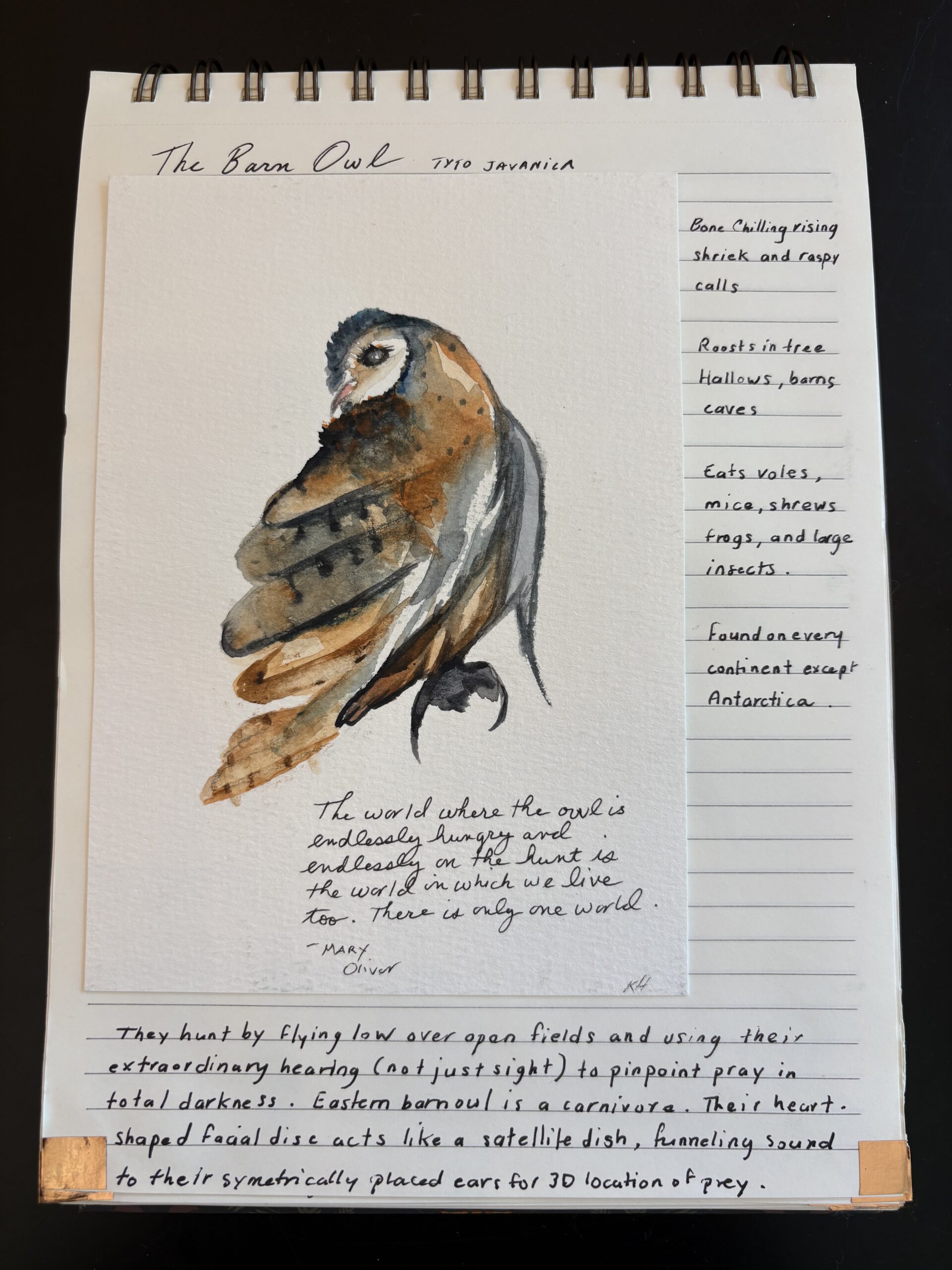
The Barn Owl (Tyto alba)
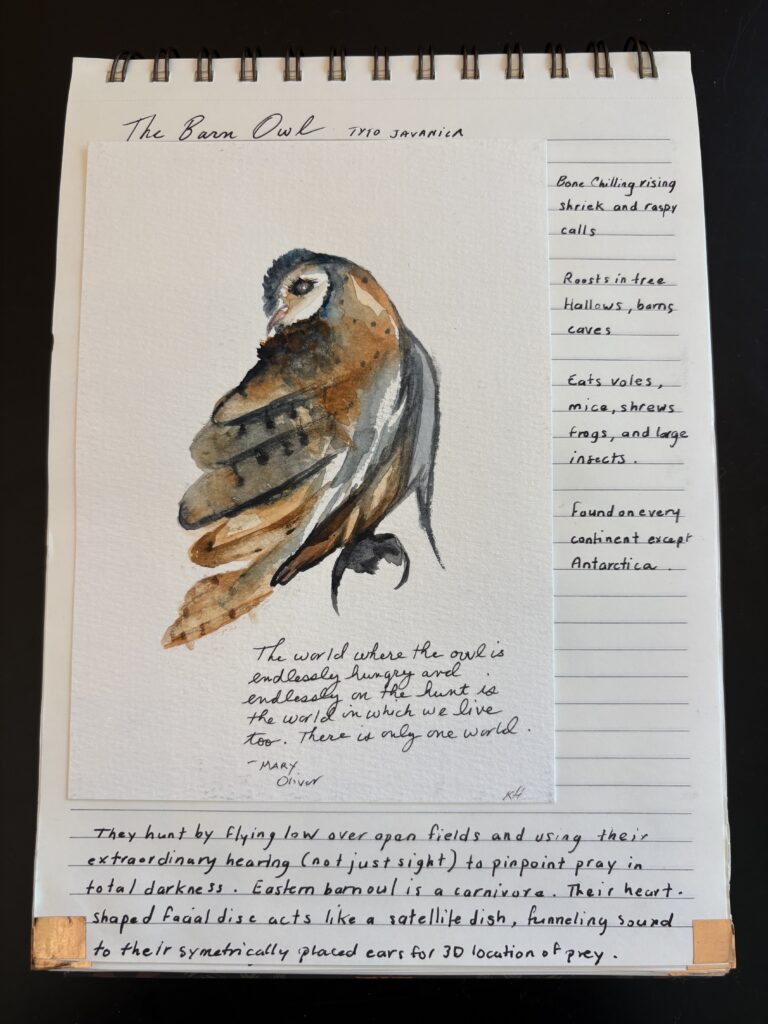
with handwritten field notes.
Painted on a Sunday afternoon after reading Mary Oliver on owls.
Call
Not a hoot. The barn owl’s call is a bone-chilling, rising shriek — a long, raspy scream that has probably launched a thousand ghost stories. If you’ve ever heard one at night near an old barn, you understand immediately why so many cultures wrapped this bird in omen and myth.
Habitat
Roosts in tree hollows, barns, caves, and abandoned buildings — quiet, enclosed places at the edges of open country. It hunts the fields and meadows nearby, flying low and slow over the grass.
Diet
A carnivore through and through: voles, mice, shrews, frogs, and large insects. A single barn owl family can consume thousands of rodents in a breeding season, which is why farmers have always been glad to share the barn.
Field marks & fun facts
- Found on every continent except Antarctica — one of the most widely distributed land birds on Earth.
- It can capture prey in total darkness, by hearing alone. Its heart-shaped facial disc works like a satellite dish, funneling sound toward its ears.
- The ears themselves are set asymmetrically — one higher than the other — so sound arrives at each ear at fractionally different times and intensities. The owl’s brain converts those differences into a three-dimensional fix on a mouse moving under grass, or under snow.
- Its flight is nearly silent. Comb-like serrations on the leading edge of its wing feathers break up the air, so the owl’s own wingbeats never mask the faint sounds it’s hunting by.
Reflect
The barn owl is the special operator of the bird kingdom. Highly specialized. Works alone. Deploys at night. Custom sensory equipment. It doesn’t merely tolerate conditions that ground every other hunter — darkness is its operating advantage.
But here’s the part I keep turning over: the barn owl doesn’t see better in the dark. It listens better. When one channel of information fails, precision migrates to another — and everything about this animal’s body is organized around that migration. The face itself becomes an instrument for collecting sound. Even its silence is functional: it quiets its own noise so it can hear what matters.
There’s a human note in that. The performers I’ve spent my career around — athletes, operators, people who work where the lights are off, literally or otherwise — are not the ones with superhuman sight. They’re the ones who, when the obvious signal disappears, have trained another way of knowing. They’ve built the facial disc. They’ve quieted their own wingbeats. Attention, it turns out, is less about looking harder and more about removing the noise between you and the signal.
The world where the owl is endlessly hungry and endlessly on the hunt is the world in which we live too. There is only one world. — Mary Oliver, “Owls,” in Owls and Other Fantasies
One world. The owl’s and ours. The only question is what we’ve trained ourselves to hear in it.